
Reviewed · NEW DELHI
Half Day Religious Enlightenment
Delhi’s religious life comes into focus on this compact tour, which takes you from the quiet white petals of the Lotus Temple to the communal kitchen at Gurudwara Bangla Sahib. In between, you visit ISKCON and the huge Akshardham complex, getting a useful introduction to Bahá’í, Hindu, and Sikh traditions without spending a full day on the road.
I like the private vehicle and guide, since Delhi’s distances and traffic can make independent temple-hopping slow. I also like the range of stops: each place gives you a different look at worship, architecture, and community life. The main drawback is the pace. Four major sites in four to five hours means short visits, and Akshardham receives only about an hour.
In This Review
- Key points at a glance
- Why this four-stop route works
- Lotus Temple: a calm start in white marble
- ISKCON Temple Delhi: Krishna worship with a global reach
- Akshardham: one hour for Delhi’s largest visual spectacle
- Bangla Sahib: seeing Sikh service in action
- What the private guide adds
- Is $60 a fair price?
- Timing, pickup, and practical details
- Who should book this religious tour?
- Should you book Half Day Religious Enlightenment?
- FAQ
- How long does the religious tour take?
- What sites are included?
- Is hotel pickup available?
- Is transportation included?
- Is the tour private?
- Is a guide included?
- Are admission tickets included?
- Are food and drinks included?
- Can I cancel for a full refund?
Key points at a glance
- Four distinct religious settings: Visit the Lotus Temple, ISKCON Temple Delhi, Swaminarayan Akshardham, and Gurudwara Bangla Sahib.
- Private transport and guide: Your group travels in an air-conditioned vehicle with a private English-speaking local guide.
- Community life at Bangla Sahib: The Sikh gurdwara includes a visit to its langar, or community kitchen.
- A useful short introduction: The tour suits a first visit to Delhi when you want cultural context but have only half a day.
- Admissions are listed as included: Each itinerary stop specifies an admission ticket, reducing small extra costs during the outing.
- Timing needs confirming: Hotel pickup and drop-off are offered, but the listed meeting point is United Coffee House in Connaught Place.
Why this four-stop route works
Many Delhi sightseeing trips focus on forts, tombs, and imperial buildings. This one takes a different path. You spend the morning or afternoon looking at how people worship and serve one another today.
That difference matters. The Lotus Temple introduces the Bahá’í faith through an uncluttered building open to people of all religions. ISKCON presents a modern international Hindu movement centered on Krishna. Akshardham gives you scale, ornament, and formal Hindu devotion. Bangla Sahib brings the focus back to service, equality, and shared meals.
I like that the route does not treat religion as decoration. The guide is there to explain what you are seeing and answer questions. A strong guide can make the difference between simply entering four buildings and understanding why each one matters.
The tour is private, so only your own group participates. That gives you more room to ask questions and adjust the conversation to your interests. It does not necessarily mean you can change the whole route, though. The advertised plan is built around four specific stops and a short overall schedule.
Other New Delhi tours people pair with this one:
- Old & New Delhi City Tour – Half or Full Day Options Available
★ 5.0 · 4,811 reviews - Old & New Delhi City Tour – Choose Half or Full Day Experience
★ 5.0 · 4,513 reviews - Same Day Taj Mahal, Agra Fort & Baby Taj Tour from Delhi by Car
★ 5.0 · 4,304 reviews
Lotus Temple: a calm start in white marble
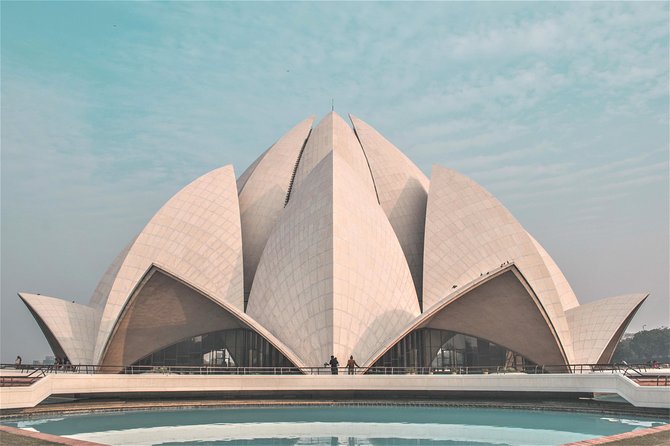
Your first stop is the Lotus Temple, reached by private air-conditioned vehicle after pickup in Delhi or the NCR area. The visit is scheduled for about 30 minutes, with admission included.
The temple is associated with the Bahá’í faith, founded by Bahá’u’lláh in the nineteenth century. Its design is the immediate attraction: a large white structure shaped like a lotus flower. The flower is important in Indian religious and cultural life, and the building uses that familiar form to create a place meant for quiet reflection.
Your guide can help connect the architecture with Bahá’í ideas about the unity of religions. That context is useful because the building itself is deliberately simple inside. You should not expect a conventional shrine filled with statues, colorful images, or a busy ritual program.
Thirty minutes is enough for a first look and a short explanation, but it is not a long contemplative visit. If you like architecture or comparative religion, you may wish the schedule allowed more time. Still, beginning here sets the right tone. The visit asks you to observe before the route becomes more visually and socially active.
ISKCON Temple Delhi: Krishna worship with a global reach
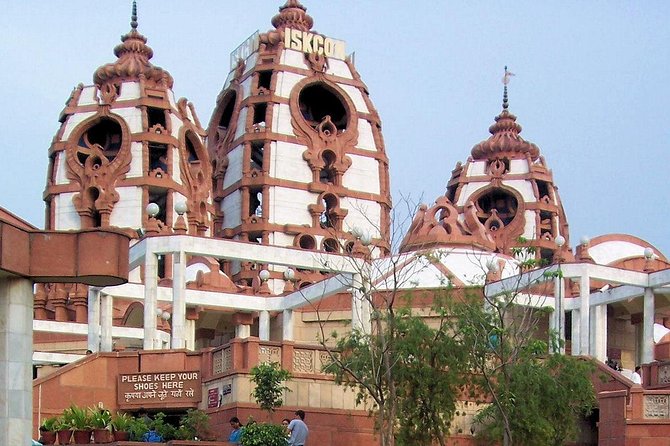
The second stop is ISKCON Temple Delhi, also planned for around 30 minutes. ISKCON began in New York City as part of the International Society for Krishna Consciousness, and it has since built temples in many countries.
The guide introduces you to Krishna as one of the central figures in the tradition and explains the religious ideas connected with the movement. The stop is especially useful if you have noticed Hare Krishna communities elsewhere but never understood where the movement came from or how it fits within Hindu practice.
This visit gives the tour a different feel from the Lotus Temple. The Bahá’í site is quiet and spare, while ISKCON offers a more clearly defined devotional setting. The contrast helps you see that Delhi’s religious life is not one single tradition with minor variations. Different communities use different buildings, symbols, and forms of worship.
Again, the half-hour schedule is brief. You will get an introduction rather than a detailed study of ISKCON theology. I would treat this as a focused orientation, not as a stand-alone temple visit. If you have a particular interest in Krishna devotion, ask your guide questions early so the limited time is used well.
Akshardham: one hour for Delhi’s largest visual spectacle
Swaminarayan Akshardham is the longest stop, with about one hour set aside. It is a vast Hindu temple complex and is described as the third-largest Hindu temple in the world according to Guinness World Records.
The scale changes the rhythm of the tour. After two shorter introductions, you arrive at a site where the architecture itself demands attention. The stop is designed for walking around the large complex and taking in its carved surfaces, broad spaces, and formal Hindu setting.
Akshardham is likely to be the most visually impressive part of the route, but the one-hour limit is important. A place of this size can easily absorb far more time. You will see the main areas included in the visit, but you should not expect to explore every corner or take part in every possible activity.
The schedule also means that the tour is more about orientation than complete coverage. Your guide can explain the Swaminarayan tradition and point out features that would be easy to miss on your own. That is a good use of a short visit, especially when the complex feels too large to understand at first glance.
If you want a slow architectural study, this tour may feel rushed here. If you want to add four major religious sites to a limited Delhi schedule, the hour gives you a practical taste without taking over your day.
Same city, a completely different day out:
- Taj Mahal Day Tour from Delhi by Superfast Train – TOP RATED TOUR
★ 5.0 · 4,166 reviews - Delhi: Old and New Delhi Private Full or Half-Day Tour
★ 4.9 · 3,776 reviews - Full Day Taj Mahal, Agra Fort & Baby Taj Tour from Delhi by Car
★ 5.0 · 3,647 reviews - From Delhi: Taj Mahal & Agra Private Day Trip with Transfers
★ 4.9 · 3,181 reviews
Bangla Sahib: seeing Sikh service in action
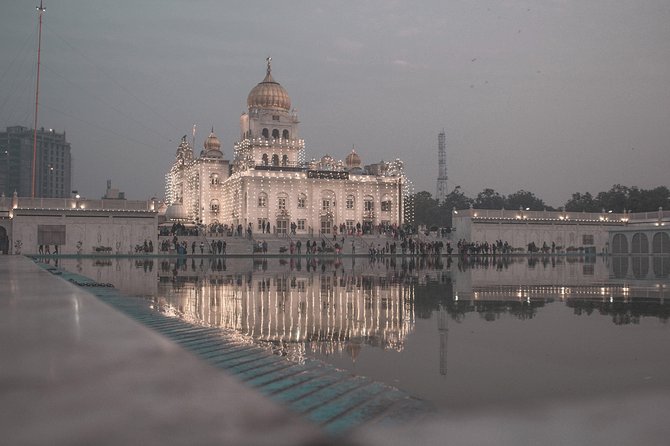
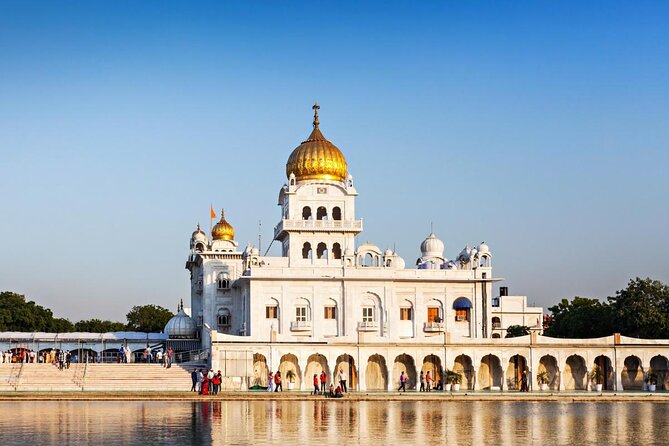
The final stop is Gurudwara Bangla Sahib, described as Delhi’s largest gurdwara. You spend about 30 minutes here, including a look at the community kitchen, known as the langar.
This is one of the most valuable parts of the experience because the focus moves from buildings to service. Sikh gurdwaras commonly provide food to people regardless of faith or social position, and the langar helps you understand the principle through a working community institution.
Your guide explains Sikh life and helps you approach the site respectfully. A gurdwara is a place of worship, not only a sightseeing stop, so expect the visit to require attention to local customs. The provided information does not specify a dress code or exact entry rules, so ask your guide what is required when you arrive.
Thirty minutes gives you time to see the gurdwara and learn about the kitchen, but not to study every part of the complex. The short stop works because the central idea is clear: Sikh religious practice includes practical service to others.
For me, this is the stop that gives the tour its strongest human connection. The Lotus Temple and Akshardham are memorable buildings, but Bangla Sahib shows how belief can shape everyday action.
What the private guide adds
The experience includes a private English-speaking local guide. That matters in Delhi, where a sign or architectural detail may tell you what a building is, but not why it was built or how the community uses it.
A good guide should help you compare the four traditions without flattening them into a single lesson. You can ask about the Bahá’í approach to worship, Krishna devotion at ISKCON, the Swaminarayan tradition at Akshardham, and Sikh service at Bangla Sahib.
The company has used a guide named Deepak on other Delhi outings. The supplied details do not guarantee that Deepak will lead this particular religious tour, so you should not book it expecting a specific guide unless the operator confirms his availability. The important point is that the booking includes a private guide rather than a shared group leader.
The private format is useful for families, couples, and small groups with different levels of interest. You can ask for more explanation at one temple and keep moving at another. The tradeoff is that a private tour often costs more per person than a large group excursion, although the $60 rate includes several useful services.
Is $60 a fair price?
At $60 per person, the value depends on how many people are in your group and how much you value convenience. The price includes hotel pickup and drop-off, an air-conditioned vehicle, and a private English-speaking guide. Admission tickets are listed for each of the four stops.
You are paying for more than entry to temples. Delhi traffic can make a short route consume much of a day, and private transport saves you from arranging several separate rides. The guide also gives the visits a common thread, which is especially useful if this is your first time comparing India’s religious traditions.
The value is strongest for a small group that wants a planned cultural outing without managing transport. It is less attractive if you prefer to linger at one site, travel by public transport, or visit only one or two temples.
Meals and drinks are not included, and gratuities are recommended. The tour lasts approximately four to five hours, so plan food separately rather than expecting a meal at one of the stops.
Timing, pickup, and practical details
The stated duration is four to five hours. The planned visits add up to about two and a half hours, so the rest of the time allows for driving, pickup, drop-off, and Delhi traffic. Do not schedule another fixed appointment immediately afterward.
Hotel pickup and drop-off are offered, but the listed start point is United Coffee House at Rajiv Chowk in Connaught Place. The listed end point is the same meeting point. Because those details do not perfectly match the hotel pickup language, confirm the exact pickup arrangement after booking.
Confirmation is provided at booking. The activity is near public transportation, and most people can participate. It is a private activity, so only your group joins the guide.
The route is best for someone who wants an organized introduction rather than a slow, specialist visit. You should also be ready for walking around temple grounds and spending time in active religious settings. The supplied information does not give detailed accessibility or dress instructions, so ask the operator before departure if either issue is important to you.
Free cancellation is available if you cancel at least 24 hours before the local start time. Cancellations or changes made within 24 hours are not refunded or accepted.
Who should book this religious tour?
I would recommend it to you if you have only half a day in Delhi and want more than monuments. It gives you four different perspectives in one outing, with a guide to explain the basic ideas and customs.
It also suits first-time visitors who feel uncertain about entering religious buildings on their own. The private guide can help you understand what is happening and how to behave respectfully.
Families may find the variety helpful. The route changes every 30 minutes or hour, so it does not ask you to spend an entire afternoon in one museum or temple. Small groups can also make good use of the private format by asking questions at their own pace.
I would hesitate if your main goal is photography, detailed architecture, or extended prayer and reflection. The schedule is tight, especially at Akshardham, and four stops can feel like a lot. You may prefer a single-site visit if you want to see every detail.
Should you book Half Day Religious Enlightenment?
Book this tour if you want an efficient, private introduction to Delhi’s religious variety, especially when air-conditioned transport and hotel pickup are worth paying for. The combination of the Lotus Temple, ISKCON, Akshardham, and Bangla Sahib gives you a clear sequence from architecture and belief to community service.
Skip it if you dislike short visits or want a flexible day with no fixed route. For everyone else, $60 is a reasonable price for a private guide, vehicle, and four listed admissions, provided you confirm the pickup point and accept the brisk pace.
FAQ
How long does the religious tour take?
The experience lasts approximately four to five hours.
What sites are included?
The route includes Lotus Temple, ISKCON Temple Delhi, Swaminarayan Akshardham, and Gurudwara Bangla Sahib.
Is hotel pickup available?
Yes. Hotel pickup and drop-off in Delhi or the NCR area are included, although United Coffee House in Connaught Place is also listed as the meeting point. Confirm the exact arrangement after booking.
Is transportation included?
Yes. Transportation is provided in a private air-conditioned vehicle.
Is the tour private?
Yes. Only your group participates in the activity.
Is a guide included?
Yes. A private English-speaking local guide is included.
Are admission tickets included?
Admission tickets are listed as included for each stop in the scheduled itinerary.
Are food and drinks included?
No. Meals and drinks are not included.
Can I cancel for a full refund?
Yes, if you cancel at least 24 hours before the experience’s local start time. Cancellations or changes made less than 24 hours in advance are not refunded or accepted.
Just added around New Delhi
- Delhi: All-Inclusive Full or Half Day Tour With Hotel Pickup★ 5.0 · 3 reviews
- Skip the line: Taj Mahal Agra Private Day Trip From Delhi By Car★ 5.0 · 3 reviews
- From Delhi : All Inclusive Taj Mahal Tour by Gatimaan Express★ 5.0 · 3 reviews
- Delhi: Old and New Delhi One Day Private Guided City Tour★ 5.0 · 3 reviews
- New Delhi Night City Tour★ 5.0 · 3 reviews
- Old Delhi Half day private city tour★ 5.0 · 3 reviews
- A full-day tour of Old & New Delhi Monument Express Entry★ 5.0 · 3 reviews
- Sultanpur Bird Sanctuary Tour Near Delhi★ 5.0 · 3 reviews