
Reviewed · QUTUB MINAR TOURS
A Walk to Remember (Qutub Complex Heritage Walk)
The best thing about this walk is that it treats the Qutub Complex as more than a photo stop. You move through a whole collection of monuments, from the 11th to the 18th century, and connect mosques, tombs, towers, gates, and royal buildings to the changing story of Delhi. I like the small group of no more than 12 and the focus on storytelling. I also like that admission and taxes are included, so the $44 price is easy to understand.
The main drawback is simple: there is no pickup. You must reach the meeting point at Qutab Minar in Mehrauli on your own, and two hours may feel brief if you want every structure explained at length. The experience also depends on good weather and a minimum group size.
In This Review
- Key points at a glance
- Why the Qutub Complex rewards a guided walk
- Qutub Minar gives the walk its anchor
- Alai Minar shows the ambition of the complex
- Tombs and the royal graveyard add a human scale
- The madrasa and Mughal Sarai reveal the wider setting
- Alai Darwaza and the Quwwat-ul-Islam Mosque
- What two hours really allows
- The guide makes the biggest difference
- Is $44 a fair price?
- Who should book this walk
- Practical details before you book
- Should you book A Walk to Remember?
- FAQ
- Where does the Qutub Complex heritage walk start?
- Where does the activity end?
- How long does the tour last?
- Is admission included?
- Is hotel pickup included?
- What monuments are covered?
- How many people can join the tour?
- Can I cancel for a full refund?
Key points at a glance
- A full historic complex, not just one tower: See Qutub Minar alongside tombs, mosques, gates, a royal graveyard, and a former madrasa.
- Parul is the named guide to ask for: The strongest praise centers on Parul’s clear explanations, local knowledge, and lively storytelling.
- Two hours with a group capped at 12: Small enough for a more personal walk, but short enough to fit into a busy Delhi day.
- Admission and taxes are included: The $44 fee covers the stated tour costs, though transportation to the meeting point is your responsibility.
- Start and finish at Qutab Minar: There is no hotel pickup, and the activity returns to its starting point.
- Best for history-minded visitors: The walk suits anyone who wants context and connections instead of a quick look at the famous minaret.
Why the Qutub Complex rewards a guided walk
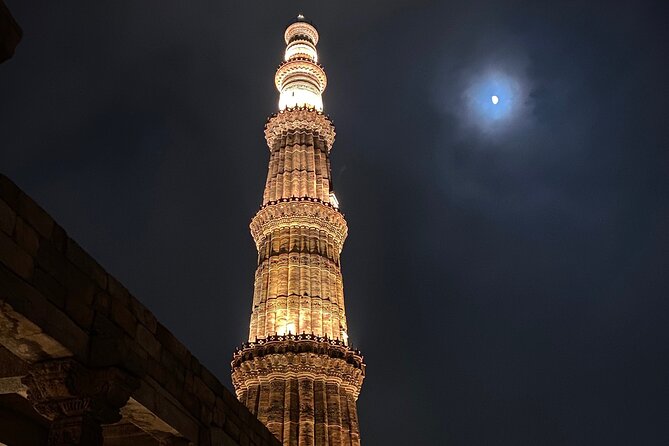
Qutub Minar gets the attention, quite fairly. Its height, carved surfaces, and age make it one of Delhi’s essential sights. But the tower is only one piece of the site, and seeing it alone leaves gaps in the story.
The Qutub Complex contains monuments dating from the 11th through the 18th century. That long span matters. You are not looking at one finished monument built in one moment. You are moving through a place shaped by different rulers, purposes, and building campaigns over many centuries.
That is where a guide earns the fee. A good explanation can show how the tower relates to the mosque beside it, why a tomb sits where it does, and how later buildings changed the meaning of the site. Instead of walking from one stone object to another, you get a clearer sense of Delhi as a settlement that grew and changed over time.
The guide named most often in the supplied feedback is Parul. She is described as a strong storyteller who explains Delhi’s past in an enjoyable, easy-to-follow way. If she is available for your date, you can ask about requesting her, though guide assignment should be confirmed before booking.
More Qutub Minar visits:
- 09 Hour Tour Of Delhi With India Gate Qutab Minar And Humayuns Tomb
★ 5.0 · 30 reviews - Skip-the-line Qutub Minar Private Tour with Transfer Option
★ 4.7 · 17 reviews - New Delhi: Qutub Minar Light & Sound Show Tour
★ 4.3 · 15 reviews
Qutub Minar gives the walk its anchor
Your walk begins at Qutub Minar, the best-known monument in the complex. The tour description places this as the central stop, but the experience is designed to move beyond the tower and its immediate fame.
Qutub Minar provides a useful starting point because it gives you a visual reference for the entire visit. From there, the guide can place nearby buildings into a wider story. You will not simply hear facts about height or construction. The stated purpose of the walk is to explain the settlement of Delhi through the monuments gathered around the minaret.
That approach is useful if you have limited time. A self-guided visit can show you the major shapes and carvings, but it may not make clear why so many different structures are grouped together. With a guide, the tower becomes the first chapter rather than the whole book.
I would allow a little extra time before the start to find the meeting point at Qutab Minar, Seth Sarai, Mehrauli. The supplied details identify this as both the starting and ending point, so you should not expect to be dropped elsewhere after the walk.
Alai Minar shows the ambition of the complex
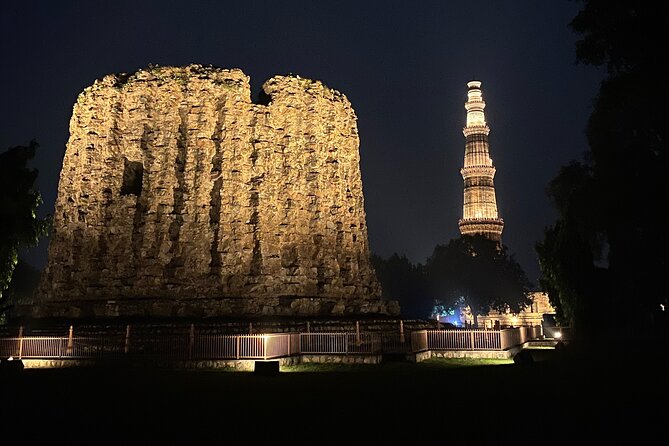
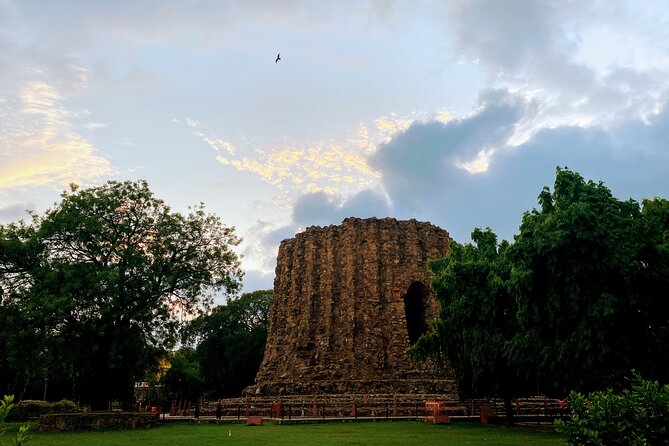
Alai Minar is one of the stops included in the route. It offers an important contrast with Qutub Minar because the complex contains not just completed monuments, but also evidence of grand plans and changing fortunes.
The tour information does not promise a detailed explanation of the unfinished tower, so I would treat the guide’s account as the key part of this stop. Ask how Alai Minar was meant to relate to the existing structures and what its presence tells you about the ambitions of its builder.
This is one of the places where a walking guide can add value without adding more distance. The monument is already in front of you. What you need is a clear explanation of why it matters and how it fits the larger site.
Tombs and the royal graveyard add a human scale
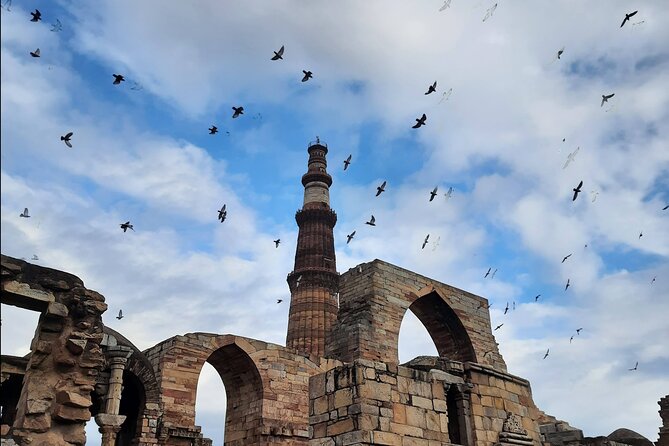
The route includes the Royal Graveyard, Iltutmish Tomb, and the tomb of Alauddin Khilji. These stops shift the focus from monumental height to people, power, and memory.
Tombs can be easy to rush past when a famous tower is nearby. I prefer having them included because they make the complex feel less like a collection of architectural fragments. They remind you that the site was shaped by rulers and court life, not just by builders and stonework.
Iltutmish’s Tomb is particularly useful as part of the sequence because it connects a named ruler with the early period of the complex. The Alauddin Khilji Tomb adds another figure and another stage in Delhi’s development. The Royal Graveyard widens the view beyond one celebrated person.
The available information does not give a full description of each tomb’s decoration or condition, so I would not book this expecting a specialist architectural lecture on every carving. Instead, expect the guide to use these structures to explain the people and periods behind the site.
More heritage walks in New Delhi:
- The Great Indian Food Tour: Old Delhi Food and Heritage Walk
★ 5.0 · 1,698 reviews - Old Delhi Heritage Walking Tour
★ 5.0 · 247 reviews - 3-hour Old Delhi Heritage Walking tour with Rickshaw Ride
★ 5.0 · 240 reviews - 3-Hour Old Delhi Heritage Walking tour with Rickshaw ride
★ 4.6 · 158 reviews
The madrasa and Mughal Sarai reveal the wider setting

The itinerary also includes the Madarsa and Mughal Sarai. These are valuable stops because they point to functions beyond worship and royal burial.
A madrasa suggests learning and religious study. A sarai points to movement, lodging, and the practical life that supported a major historic center. Together, they help you see that the Qutub Complex was not just a monument zone built for display.
The exact amount of time spent at each building will depend on the guide and the group. In a two-hour walk, some stops will receive a short explanation rather than a long pause. That is a fair trade if you want broad coverage, but it means you should speak up if one structure interests you most.
I like this part of the route because it gives the visit a more grounded feel. The dramatic tower draws you in, but supporting buildings explain how a historic settlement worked.
Alai Darwaza and the Quwwat-ul-Islam Mosque

Alai Darwaza and the Quwwat-ul-Islam Mosque are two of the route’s most important architectural stops. They also help explain why the complex is much more rewarding when you understand relationships between the buildings.
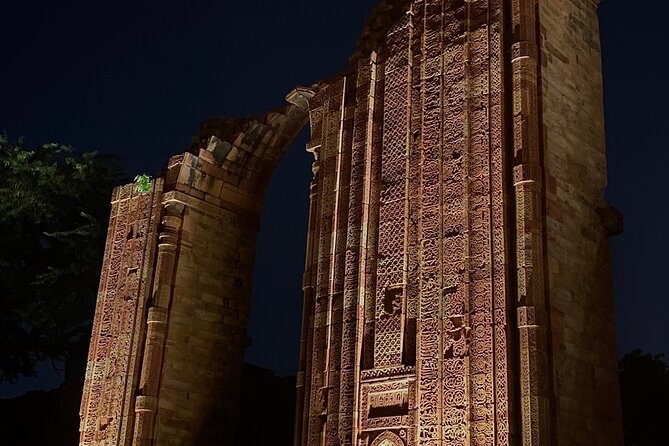
Alai Darwaza is included as a gateway, not simply as another isolated monument. Gates frame movement and establish an approach, so your guide can use it to explain how people once entered and experienced the complex.
The Quwwat-ul-Islam Mosque gives the walk another central point. Its name and position make it part of the site’s religious and political story, while its surviving architectural details invite close looking. The supplied details do not specify exactly which features the guide will emphasize, so you should expect interpretation rather than a fixed lecture with a guaranteed list of details.
This is where Parul’s reported strength as a storyteller matters most. A dry list of dates can make a complex like this blur together. A guide who connects a gateway, mosque, tower, and tombs into one narrative can make the walk easier to remember.
What two hours really allows

Two hours is a sensible length for a first visit. It gives you enough time to cover the main cluster without turning the outing into an exhausting half-day commitment.
At the same time, you should set realistic expectations. The route names nine major elements or groups: Qutub Minar, Mughal Sarai, Alai Minar, the Royal Graveyard, Iltutmish Tomb, the Madarsa, Alauddin Khilji Tomb, the Quwwat-ul-Islam Mosque, and Alai Darwaza. That is a lot of ground for one short walk.
You will likely get a broad explanation of the complex, with more attention given to the most important monuments. If you already have a strong interest in medieval Delhi or Islamic architecture, you may want more time afterward to look around independently. If you are visiting Delhi for the first time, the two-hour format gives you a useful framework without taking over your day.
The experience ends where it begins. That makes it easy to plan another activity afterward, provided you allow time for your own transport and do not assume the guide will take you to your next stop.
The guide makes the biggest difference
The strongest feature of this experience is the guide’s role. The feedback supplied for the tour repeatedly praises Parul’s storytelling, cultural understanding, and ability to make the visit enjoyable.
That is more useful than a promise of a long list of facts. At a complex site, you need someone who can choose what matters, explain it in plain language, and keep the sequence clear. The comments about Parul point to those qualities: she is described as smart, extremely informed about the monuments, and fun to spend time with.
You should still remember that a named guide is not automatically guaranteed unless confirmed. Ask the provider if Parul can lead your walk. If another guide is assigned, the quality may depend on that person’s approach.
The group limit of 12 is another practical advantage. It is not a private tour, but it is small enough that asking a question should be possible. A small group also makes it easier to hear the guide and stay together among the monuments.
Is $44 a fair price?
At $44 per person, this is not the cheapest way to see Qutub Minar. You are paying for a guided interpretation of the wider complex, not simply entry and a quick look at the tower.
The value depends on how you like to visit historic places. If you are content to read signs and walk independently, the price may feel high, especially since you must arrange your own transport. If you want the site explained in context and prefer a short, organized outing, the fee is easier to justify.
Admission and all stated fees and taxes are included. That removes some uncertainty from the price. The key omission is pickup, so budget for getting to Seth Sarai in Mehrauli.
I see the tour as good value for a first visit if the guide is strong. The combination of a small group, a two-hour route, and coverage of the wider complex gives you more than a basic landmark visit. It is less suitable if you want a private guide, a very slow photography session, or a full-day study of every monument.
Who should book this walk
I would choose this experience if you want the Qutub Complex to make sense as a whole. It suits first-time visitors to Delhi, history fans who prefer explanation to wandering, and people with only a few hours available.
It also fits solo visitors or small parties who like meeting a few other people but do not want a large sightseeing crowd. The maximum group size is 12, and most people can participate according to the supplied details.
You may want another option if hotel pickup is important, if you need a completely private experience, or if you want to spend much longer at each monument. The walk also requires good weather, and the provider may cancel if the minimum number of participants is not reached.
Practical details before you book
Confirmation is provided when you book, and the activity accepts a mobile ticket. The meeting point is Qutab Minar, Seth Sarai, Mehrauli, New Delhi, Delhi 110030, India.
The area is near public transportation, which helps with reaching the start, but the tour does not include pickup. Plan to arrive at the stated meeting point rather than expecting a hotel collection.
Most people can participate, and the walk lasts approximately two hours. Since the route covers several historic structures, comfortable walking clothing and sensible footwear are practical choices, though the supplied details do not list a formal dress code or special equipment requirement.
Free cancellation is available if you cancel at least 24 hours before the local start time. Changes or cancellations inside that window are not accepted for a refund. If bad weather or an insufficient number of participants causes the provider to cancel, you can choose another date or experience, or receive a full refund.
Should you book A Walk to Remember?
Book it if you want a guide to connect Qutub Minar with the tombs, mosque, gate, madrasa, sarai, and other structures around it. The tour’s best qualities are its focused two-hour format, small group size, included admission, and the clear storytelling associated with Parul.
Skip it if you mainly want independent time, hotel pickup, or a slow architectural study. For most first-time visitors who want the Qutub Complex explained rather than merely photographed, $44 is a reasonable price for a well-led introduction. Ask about Parul’s availability before booking, then arrange your own transport to Mehrauli and leave room in your schedule for a little extra looking after the guided walk.
FAQ
Where does the Qutub Complex heritage walk start?
The walk starts at Qutab Minar, Seth Sarai, Mehrauli, New Delhi, Delhi 110030, India.
Where does the activity end?
The activity ends back at the meeting point at Qutab Minar.
How long does the tour last?
The tour lasts approximately two hours.
Is admission included?
Yes. Admission tickets, all stated fees, and taxes are included.
Is hotel pickup included?
No. Pickup is not included, so you must make your own way to the meeting point.
What monuments are covered?
The route includes Qutub Minar, Mughal Sarai, Alai Minar, the Royal Graveyard, Iltutmish Tomb, the Madarsa, Alauddin Khilji Tomb, the Quwwat-ul-Islam Mosque, and Alai Darwaza.
How many people can join the tour?
The activity has a maximum of 12 participants.
Can I cancel for a full refund?
Yes, if you cancel at least 24 hours before the experience start time. Cancellations or changes made less than 24 hours in advance are not accepted for a refund.
More Walking Tours in New Delhi
- Breakfast Walk in Old Delhi
★ 5.0 · 449 reviews - Delhi Food Walk: Rickshaw Ride, Street Eats & Market Tour
★ 5.0 · 401 reviews - New Delhi Slum Walking Tour
★ 5.0 · 360 reviews - The Great Indian Food Tour: Old Delhi Food and Heritage Walk
★ 5.0 · 106 reviews
More Historical Tours in New Delhi
- Old Delhi Food, Heritage&Cultural Walk with Rickshaw ride to Masterji Kee Haveli
★ 5.0 · 742 reviews - Old Delhi: Spices, Heritage and Bazaars Walking Tour
★ 5.0 · 173 reviews - Gandhi Delhi Private History Adventure Tour
★ 5.0 · 127 reviews - Delhi’s historical 7 hours experience tour
★ 5.0 · 115 reviews
Just added around New Delhi
- Delhi: All-Inclusive Full or Half Day Tour With Hotel Pickup★ 5.0 · 3 reviews
- From Delhi : All Inclusive Taj Mahal Tour by Gatimaan Express★ 5.0 · 3 reviews
- Skip the line: Taj Mahal Agra Private Day Trip From Delhi By Car★ 5.0 · 3 reviews
- Old Delhi Half day private city tour★ 5.0 · 3 reviews
- Delhi: Old and New Delhi One Day Private Guided City Tour★ 5.0 · 3 reviews
- New Delhi Night City Tour★ 5.0 · 3 reviews
- A full-day tour of Old & New Delhi Monument Express Entry★ 5.0 · 3 reviews
- Sultanpur Bird Sanctuary Tour Near Delhi★ 5.0 · 3 reviews
Qutub Minar Tours, compared.

09 Hour Tour Of Delhi With India Gate Qutab Minar And Humayuns Tomb
Read our review →
Skip-the-line Qutub Minar Private Tour with Transfer Option
Read our review →

Private Delhi Tour: Lotus Temple, Qutub Minar and Dilli Haat
Read our review →
Private Walking Tour: South Delhi Heritage including Qutub Minar and Mehrauli Archaeological Park
Read our review →
Private Tour in Mehrauli Archaeological Park & Qutub Minar
Read our review →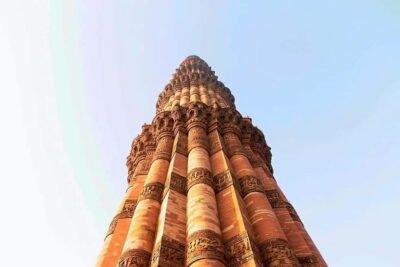
Qutub Minar UNESCO World Heritage Site Walking Tour
Read our review →
Mehrauli Archaeological Park Tour with Qutub Minar
Read our review →Browse the lists this tour appears in