Reviewed · GOLDEN TRIANGLE TOURS
Golden Triangle Tour – Delhi Agra Jaipur
The Taj Mahal at sunrise is the centerpiece, but this four-day trip gives you much more than a quick Agra photo stop. You move through Delhi’s Mughal monuments, Agra’s imperial sites, and Jaipur’s royal palaces in one private journey, with guides and drivers handling the long road sections.
I like the small-group format and the practical touches: WiFi, bottled water, snacks, first aid, and WhatsApp support. I also like the chance to spend more time at a favorite site instead of being marched along. The drawback is the pace. Delhi alone fills a long day, and the drive to Jaipur plus a full sightseeing schedule can leave you tired.
In This Review
- Key points at a glance
- Why this route works in four days
- Delhi begins with towers, tombs, and a crowded market
- Old Delhi brings the strongest sense of place
- Humayun’s Tomb explains the road to the Taj Mahal
- Sunrise at the Taj Mahal is worth the early alarm
- Agra Fort shows the power behind the marble
- Chand Baori adds an extraordinary engineering stop
- Jaipur begins with Amber Fort on the hill
- Jaipur’s palace and observatory tell different stories
- What the $250 price really covers
- Who should book this Golden Triangle trip
- Should you book it?
- FAQ
- How long is the Golden Triangle tour?
- Is the tour private?
- Are monument entry fees included?
- Is transportation provided?
- Is breakfast included?
- Can I cancel for a full refund?
Key points at a glance

- Sunrise at the Taj Mahal: Begin Agra sightseeing before the crowds, with about two hours at India’s most famous monument.
- Private travel for your group: You avoid a large coach party and can discuss timing or adjustments with your guide.
- Three very different cities: Delhi brings Mughal and modern India, Agra brings imperial architecture, and Jaipur brings Rajput palaces and astronomical instruments.
- Long road days: The Delhi to Agra drive takes about three hours, and the route continues to Jaipur after sightseeing in Agra.
- Useful onboard support: The vehicle includes air conditioning, WiFi, water, snacks, fuel, tolls, parking, and driver service.
- Entry tickets cost extra: Monument admission is not included, so your final spending will be higher than the advertised price.
Why this route works in four days
India’s Golden Triangle links three cities that show different sides of northern India. Delhi is a giant capital with ancient quarters, colonial-era landmarks, and Mughal monuments. Agra focuses on the Mughal court and the Taj Mahal. Jaipur shifts the mood to Rajasthan, with sandstone forts, painted facades, royal courtyards, and the famous Pink City streets.
The route is efficient because it follows a sensible triangle rather than sending you back and forth. You spend the first day in Delhi, drive to Agra, continue toward Jaipur, and return to Delhi or another agreed drop-off point on the fourth day.
I would not call this a leisurely trip. The schedule includes many sites, several early starts, and substantial driving. But if you have only four days and want the classic northern India sights, the plan covers a lot of ground without adding domestic flights or train changes.
The private format matters here. You are not waiting for 50 other people to board a bus or finish lunch. The guide can help you decide if a monument deserves extra time or if you would rather keep moving. That flexibility is especially useful in Delhi, where the number of stops can easily overwhelm a first-time visitor.
More Agra and Fatehpur Sikri days:
- Same Day Taj Mahal, Agra Fort & Baby Taj Tour from Delhi by Car
★ 5.0 · 4,304 reviews - Full Day Taj Mahal, Agra Fort & Baby Taj Tour from Delhi by Car
★ 5.0 · 3,647 reviews - From Delhi: Taj Mahal & Agra Private Day Trip with Transfers
★ 4.9 · 3,181 reviews
Delhi begins with towers, tombs, and a crowded market
The Delhi day starts with Qutub Minar, a 73-meter tower built in 1193 by Qutub-ud-din Aibak, founder of the Delhi Sultanate. Its five levels and detailed stonework offer an immediate lesson in the region’s early Islamic architecture.
Allow about an hour here. The admission fee is extra, and the site is large enough that comfortable shoes help. Qutub Minar is not simply a quick tower photograph. The surrounding ruins give you a sense of how the early sultanate used monumental buildings to announce its authority.
The Lotus Temple makes a sharp change of pace. Its white, flower-shaped design dates from 1986, and the Baháʼí House of Worship welcomes people of all faiths. You have about 30 minutes, with no admission fee listed.
I would treat this as a calm pause rather than a major history stop. The building’s form is the attraction, and the visit gives your Delhi day a modern architectural counterpoint to the older monuments.
At India Gate, you stop for about 30 minutes. This war memorial honors soldiers of British India who died in various conflicts, but it is also a popular public meeting place for Delhi families. The contrast is useful: the monument carries a serious national memory, while the surrounding area feels like a living part of the city.
Parliament House comes next as a short photo stop of about five minutes. The circular Sansad Bhavan houses India’s two legislative assemblies, Lok Sabha and Rajya Sabha. You should not expect an interior visit, and the listed admission is not included.
Old Delhi brings the strongest sense of place
Jama Masjid gives you an hour with one of the largest mosques in India. Built by Shah Jahan between 1650 and 1656, it reflects the same Mughal world that produced the Taj Mahal, but on a more public and imposing scale.
Dress respectfully and follow local instructions during the visit. The admission fee is extra. Your guide can help you understand the mosque’s design and place it within the wider Mughal story, rather than leaving you with only a grand courtyard and a few photographs.
Agrasen Ki Baoli is a short 15-minute stop, but it is one of the more unusual locations in the day. This protected stepwell measures about 60 meters long and 15 meters wide. Its descending steps show how older communities managed water and created useful public spaces in a dry climate.
The stop is brief, so think of it as a concentrated look at engineering rather than a full monument visit. You pay the admission fee separately.
Then comes Chandni Chowk, Old Delhi’s market center. Give it an hour. Narrow lanes lead past spice sellers, silver jewelry shops, sari stores, and sweet shops. This is where Delhi feels most immediate and crowded, with commerce taking place at close range.
I like that the tour includes time here instead of restricting the day to formal monuments. Still, you should expect noise, tight lanes, and a less controlled setting than the major sites. Keep your belongings close and listen to your guide when moving through the market.
Humayun’s Tomb explains the road to the Taj Mahal
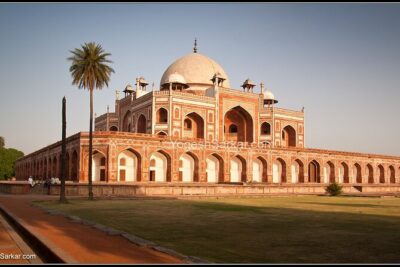
Humayun’s Tomb is one of Delhi’s most important stops. Empress Bega Begum commissioned it in 1558 for her husband, Mughal Emperor Humayun. The tomb’s formal gardens, domed structure, and marble details helped shape the architectural ideas later seen at the Taj Mahal.
You have about an hour, and the admission fee is extra. This is a good place to slow down and look at the building’s balance and garden plan. If the Taj Mahal is the grand finale of Mughal architecture, Humayun’s Tomb helps you see the earlier steps that led there.
After lunch at a local restaurant, you leave Delhi on the Yamuna Expressway. The drive to Agra takes about three hours, and the vehicle is described as air-conditioned, with WiFi, water, snacks, and first aid onboard.
The promise of a local Mughlai lunch is important. A family-run restaurant can offer a more grounded meal than a large stop built only for tour groups, though the exact restaurant is not fixed in the information provided. Confirm meal arrangements and what is included before you set out.
You check into your Agra hotel and have the evening at your own pace. That quiet stretch matters because the next morning begins early.
More Golden Triangle itineraries from New Delhi:
- 3-Days Private Golden Triangle Tour: Delhi, Agra & Jaipur by Car
★ 5.0 · 1,107 reviews - 3-Days Private Golden Triangle Tour: Delhi, Agra & Jaipur by Car
★ 5.0 · 1,098 reviews - 3-Day Delhi, Agra and Jaipur Private Tour – India Golden Triangle
★ 5.0 · 812 reviews - Four-Day Private Luxury Golden Triangle Tour to Agra and Jaipur From New Delhi
★ 5.0 · 807 reviews
Sunrise at the Taj Mahal is worth the early alarm
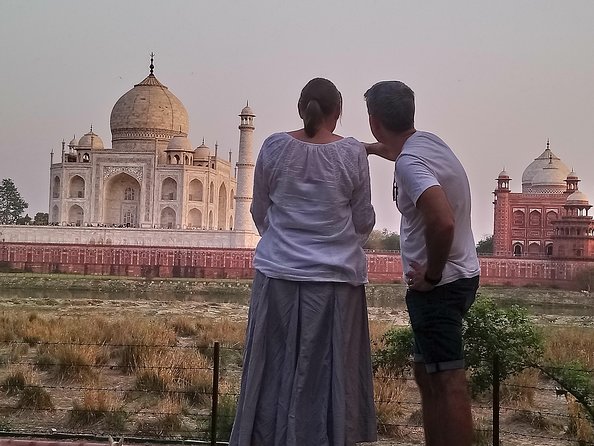
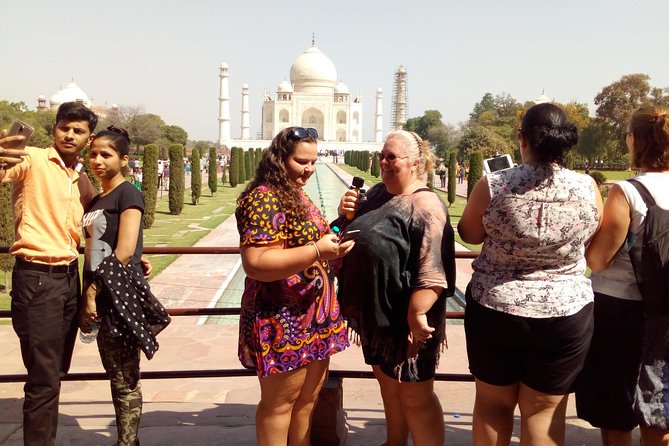
The Taj Mahal visit is scheduled for sunrise, before the main crowds arrive. You have about two hours with a guide, and the entry fee is not included.
This timing is one of the tour’s best decisions. Early light changes the marble from cool gray to warmer gold, and the grounds are generally easier to appreciate before the day’s heavier foot traffic. Your guide also provides the story of Shah Jahan and the mausoleum he built for his wife, Mumtaz Mahal.
Do not expect the Taj Mahal to be a quick stop. Two hours gives you time for the main view, close architectural details, garden lines, and the interior portion included in the guided visit. Wear shoes suited to walking and remember that admission is a separate cost.
The Taj is famous for good reason, but the experience can feel hurried if you focus only on the standard front view. I would ask your guide to point out the inlay work, the symmetry, and the way the building changes as you move around it. The private setting makes those questions easier.
Agra Fort shows the power behind the marble
Agra Fort follows the Taj Mahal, with about an hour inside. Its red sandstone walls contain royal palaces, balconies, courtyards, and Mughal gardens. This was not only a defensive structure. It was also a palace complex and a seat of imperial government.
The fort gives you a better sense of the rulers who commissioned the Taj Mahal. From its elevated sections, you may also get views toward the Taj, depending on the exact location and conditions.
Admission is extra. After the early start, the heat and walking can catch up with you here, so use the private vehicle as a chance to rest between sites.
Itmad-ud-Daula, often called the Baby Taj, takes about 30 minutes. Built between 1622 and 1628, this mausoleum shows the shift from red sandstone toward the white marble and delicate inlay associated with the Taj Mahal.
The site is smaller and quieter in feel than Agra Fort. I would not skip it simply because the Taj is the headline attraction. Its finer scale helps you notice surface decoration and design details that can be hard to appreciate in a much larger monument.
Chand Baori adds an extraordinary engineering stop
On the way toward Jaipur, the route includes Chand Baori at Abhaneri. This enormous stepwell dates from the eighth or ninth century and has about 3,500 steps descending toward the water.
You have roughly 30 minutes. That is enough to see the geometric pattern from above and understand the basic design, but not enough for a slow exploration. Admission is extra.
Chand Baori breaks up the road journey with a site that is neither palace nor tomb. It also adds practical history to the trip. Water conservation shaped daily life across northern India, and this stepwell makes that fact visible in a striking way.
Jaipur begins with Amber Fort on the hill
You arrive in Jaipur, check into your hotel, and have time to rest before the next day’s sightseeing. The following morning starts with Amber Fort, the former capital of Rajasthan until 1728.
The fort occupies a hilltop and includes Rajput courtyards, palaces, and detailed decorative work. Plan on about two hours, with a free admission notation in the schedule, though the overall inclusions say monument entry fees are not included. That inconsistency is worth clarifying before booking.
Amber Fort is one of the day’s major visits, so do not treat it as a photo stop. Your guide can help connect the fort’s buildings to Jaipur’s royal past and explain how the complex worked as a residence and seat of power.
The hilltop setting adds effort. You will be walking and dealing with stairs or uneven surfaces in parts of the complex. If you need a slower pace, say so early. The benefit of a private tour is that your guide can adjust the rhythm more easily than a fixed coach group.
Jaipur’s palace and observatory tell different stories
Jal Mahal is a 30-minute photo stop. The palace appears to float on Man Sagar Lake, and the building was renovated and enlarged by Maharaja Jai Singh II of Amber.
The schedule does not describe an interior visit, so plan to view it from the outside. This is a good short pause after Amber Fort, especially for photographs, but it should not be confused with a full palace tour.
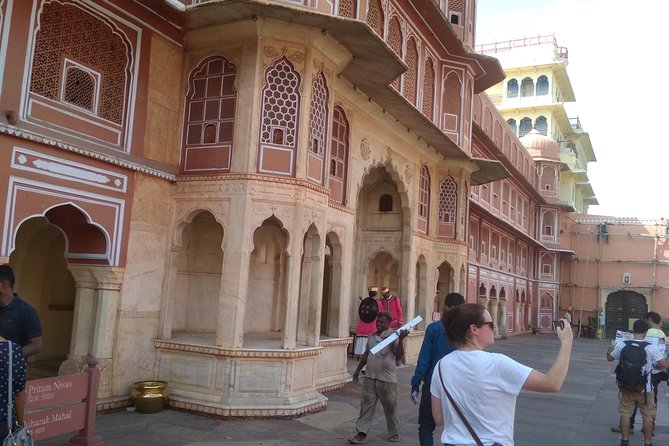
City Palace gives you about an hour inside the old royal administrative and ceremonial complex. Built in 1721, it hosted religious and cultural events for Jaipur’s Maharajas. The admission fee is extra.
This visit helps you understand Jaipur as a working royal capital rather than only a collection of colorful facades. Allow time for courtyards, palace buildings, and displays, and ask your guide to explain which parts served ceremonial and administrative roles.
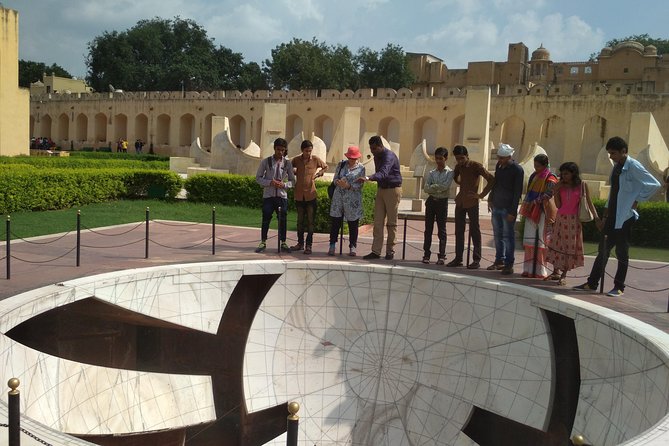
Jantar Mantar is a different kind of royal site. Built in 1734 by Jaipur’s founder, Sawai Jai Singh II, it contains 19 large astronomical instruments designed for observing the sky with the naked eye.
You have an hour here, and entry is extra. The instruments are easier to appreciate with a guide because their scale can be confusing at first. Look beyond the unusual shapes: this is a place where architecture served measurement and calculation.
Hawa Mahal closes the sightseeing day with a 15-minute stop. Built in 1799 by Sawai Pratap Singh, the five-story palace has the pink and red sandstone facade that defines Jaipur’s public image.
The short visit is enough for exterior photographs. Do not expect a full exploration of the palace. Its screened windows were designed to let royal women observe street life without being seen, a detail your guide can help bring to life.
What the $250 price really covers
At $250 per person, the tour can be good value if you want private transportation, driver service, local guides, breakfast with accommodation, and a packed route across three cities. Fuel, tolls, parking, state tax, and driver services are listed as included, which removes several common road-trip costs.
The price does not cover monument entry fees. The inclusions also say all fees and taxes are not included, which conflicts with the separate statement about state tax. Ask for a written breakdown before paying so you know the final amount.
The tour’s value improves if you are traveling as a small private group and would otherwise need to arrange three cities, multiple hotel transfers, and several guides yourself. It is less attractive if you want a slow holiday with long free periods.
The support features are practical rather than flashy. WhatsApp updates, multilingual guide options, reserved train seats when trains are used, maintained vehicles, and punctual service can reduce the small stresses that add up during a short India trip.
Past service details also point to the kind of help available. Rahman is identified as a driver who took a couple from the Radisson Blu to the station, supplied water, and stayed with them until they boarded. Raja is associated with Agra driving, while Satish is named as the trip lead on a five-day Delhi, Agra, and Jaipur journey. Confirm your own driver and guide names after booking because assignments can change.
Who should book this Golden Triangle trip
I would recommend it to a first-time visitor with four days, especially if you want the major monuments without arranging each transfer yourself. Couples and families can benefit from a private vehicle, flexible timing, and direct WhatsApp contact.
It also suits people who value cultural context. The route includes mosques, tombs, stepwells, markets, forts, royal buildings, and astronomical instruments, not just the most famous photo stops.
I would hesitate if you dislike early mornings, long drives, or tightly scheduled days. The sunrise Taj Mahal visit is excellent, but it requires an early start. Delhi’s many stops and the onward route to Jaipur demand stamina.
Free cancellation is available if you cancel at least 24 hours before the local start time. Changes made within that window are not accepted, and poor weather may lead to a new date or a full refund.
Should you book it?
Book this tour if your priority is seeing the classic Golden Triangle in a short period with private transport and local assistance. The strongest features are the sunrise Taj Mahal visit, small-group control, and the mix of famous monuments with places such as Agrasen Ki Baoli and Chand Baori.
Before confirming, ask exactly which hotels are provided, how monument tickets and taxes will be handled, and whether the return is to New Delhi or another preferred drop-off point. If you are comfortable with the pace and the extra entry costs, this is a practical way to cover Delhi, Agra, and Jaipur without wasting precious vacation time.
FAQ
How long is the Golden Triangle tour?
The experience lasts approximately four days and covers Delhi, Agra, Jaipur, and a return to New Delhi or another preferred drop-off point.
Is the tour private?
Yes. Only your group participates in the activity.
Are monument entry fees included?
No. Entry fees at the monuments are not included and must be paid separately.
Is transportation provided?
Yes. An air-conditioned vehicle is provided, along with fuel, tolls, parking, and driver services. WiFi, water, snacks, and first aid are also listed as onboard features.
Is breakfast included?
Breakfast with accommodation is included in the tour details.
Can I cancel for a full refund?
You can receive a full refund if you cancel at least 24 hours before the experience starts. Cancellations or changes made less than 24 hours in advance are not accepted for a refund.
Just added around New Delhi
- Delhi: All-Inclusive Full or Half Day Tour With Hotel Pickup★ 5.0 · 3 reviews
- From Delhi : All Inclusive Taj Mahal Tour by Gatimaan Express★ 5.0 · 3 reviews
- Skip the line: Taj Mahal Agra Private Day Trip From Delhi By Car★ 5.0 · 3 reviews
- Delhi: Old and New Delhi One Day Private Guided City Tour★ 5.0 · 3 reviews
- New Delhi Night City Tour★ 5.0 · 3 reviews
- Old Delhi Half day private city tour★ 5.0 · 3 reviews
- A full-day tour of Old & New Delhi Monument Express Entry★ 5.0 · 3 reviews
- Sultanpur Bird Sanctuary Tour Near Delhi★ 5.0 · 3 reviews
Golden Triangle Tours, compared.
3-Days Private Golden Triangle Tour: Delhi, Agra & Jaipur by Car
Read our review →3-Days Private Golden Triangle Tour: Delhi, Agra & Jaipur by Car
Read our review →
3-Day Delhi, Agra and Jaipur Private Tour – India Golden Triangle
Read our review →
Four-Day Private Luxury Golden Triangle Tour to Agra and Jaipur From New Delhi
Read our review →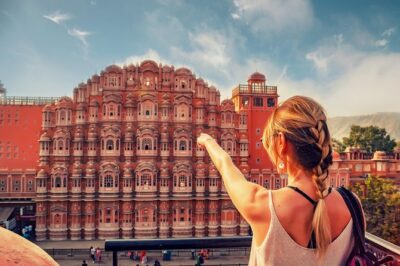
Jaipur Day Trip from Delhi by Car or Train – All Inclusive
Read our review →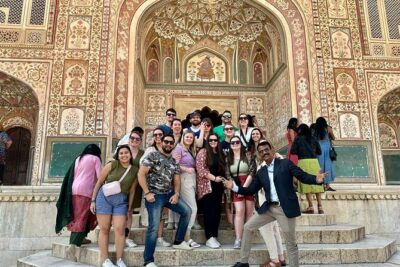
Jaipur City Private Day Tour from Delhi by Car – All Inclusive
Read our review →
5 Nights 6 Days Private Golden Triangle Tour – Delhi Agra Jaipur
Read our review →