
Reviewed · GOLDEN TRIANGLE TOURS
4 Days Private Golden Triangle Tour to Agra and Jaipur from Delhi
The Taj Mahal at sunrise is the heart of this four-day trip, but the real appeal is the sweep of it: Delhi’s Mughal and modern landmarks, Agra’s grand monuments, and Jaipur’s pink-hued palaces. You get a private vehicle and private guides, so the route can be adjusted instead of moving with a large bus group.
I like the useful door-to-door service, with pickup anywhere in Delhi, Noida, Gurugram, Ghaziabad, or Faridabad and a final drop-off at Delhi airport. I also like the thoughtful touches, including bottled water, a soft drink, tolls, parking, and the battery bus at the Taj Mahal. The main drawback is the pace: fitting so many major sites into four days means long road transfers and early starts.
In This Review
- Key points to know before booking
- A fast but rewarding Golden Triangle route
- Day one: Old Delhi streets and Delhi’s grand monuments
- Day two: the Taj Mahal, Agra Fort, and the Baby Taj
- Day three: Jaipur’s palaces, fort, and astronomical instruments
- Day four: a simple return to Delhi airport
- Private cars, hotels, guides, and group size
- What the extra cost and practical details mean
- Who should choose this four-day tour?
- Should you book it?
- FAQ
- How long does the Golden Triangle tour last?
- Where can pickup be arranged?
- Is the tour private?
- What vehicle will a small group use?
- Are hotel stays included?
- Are monument entrance tickets included?
- Is the Taj Mahal open every day?
- What happens on the final day?
Key points to know before booking
- Sunrise at the Taj Mahal: You reach India’s most famous monument early, when the light is softer and the grounds are generally more comfortable than later in the day.
- A genuinely private road trip: Your group travels in a private air-conditioned sedan, wagon, or ten-seat van according to party size.
- Delhi sightseeing is tightly packed: Chandni Chowk, Jama Masjid, a Sikh gurdwara, India Gate, Akshardham, Humayun’s Tomb, and Qutub Minar all appear on the first day.
- Fatehpur Sikri breaks up the Agra to Jaipur drive: The former Mughal city adds an important historic stop between the two better-known destinations.
- Major entry fees are extra: Budget about $55 per person for monument tickets, in addition to the advertised tour price.
- The airport finish is useful: After breakfast on day four, you return to Delhi for an international airport drop-off.
A fast but rewarding Golden Triangle route
I see this as an orientation tour rather than a slow cultural holiday. In four days, you touch three of North India’s best-known cities and visit a strong lineup of UNESCO-listed monuments, but you will spend a fair amount of time in the car.
The private setup makes the schedule more workable. You do not have to wait for a full coach to load, and the driver can take you from your hotel to each sight, then onward to Agra and Jaipur. Traffic remains a real factor. The stated driving times are estimates, so a Delhi road that looks short on a map can take much longer at busy hours.
The listed price of $6.96 per person needs careful reading. It is an unusually low starting figure and does not include monument admission, which is estimated at about $55 per person. Hotel stays are also tied to the booking option you select. The value comes from the transport, private guiding, fuel, tolls, parking, water, and airport transfer, not from treating $6.96 as the full cost of the holiday.
More Agra and Fatehpur Sikri days:
- Same Day Taj Mahal, Agra Fort & Baby Taj Tour from Delhi by Car
★ 5.0 · 4,304 reviews - Full Day Taj Mahal, Agra Fort & Baby Taj Tour from Delhi by Car
★ 5.0 · 3,647 reviews - From Delhi: Taj Mahal & Agra Private Day Trip with Transfers
★ 4.9 · 3,181 reviews
Day one: Old Delhi streets and Delhi’s grand monuments
Pickup is available between 9 and 11 a.m. from a broad area around Delhi. That flexibility helps if you have arrived the previous night or need a later morning after a flight, though a 9 a.m. departure is the wiser choice if you want to complete the full sightseeing list.
Chandni Chowk gives you a first taste of Old Delhi. This is one of the city’s oldest markets, with shops, street food, and a busy historic setting. One hour is enough for a quick look, but not for a leisurely food crawl or extensive shopping. Keep your expectations realistic: this is an introduction, not a full market tour.
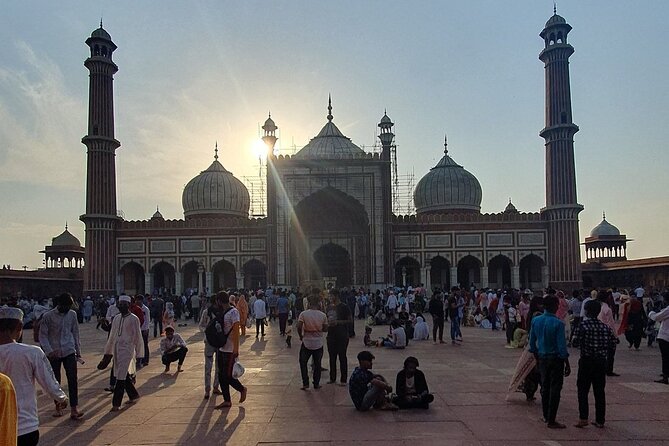
Nearby Jama Masjid is one of India’s largest and most important mosques. Shah Jahan built it in the mid-17th century, the same Mughal emperor linked to the Taj Mahal. The entrance fee is not included, and modest dress is appropriate for this religious site. One hour gives you time to see the mosque and understand its place in Old Delhi.
The Sikh gurdwara stop offers a change of mood. The details identify the site as Gurudwara Bangla Sahib, while the itinerary label also refers to Moti Bagh Sahib, so I would confirm the exact gurdwara with the operator before departure. Admission is free, and this stop adds a living religious setting to a day otherwise filled with monuments.
India Gate is a straightforward photo stop at the center of New Delhi. The 42-meter memorial honors Indian soldiers who died in World War I and the Third Anglo-Afghan War. You also pass Rashtrapati Bhavan, the President’s residence, designed by British architect Edwin Lutyens. The contrast between the Mughal old city and planned New Delhi is one of the day’s best features.
Akshardham is scheduled for about 30 minutes. The Hindu temple and cultural center opened in 2005 and is known for detailed decoration. Admission is extra, and the site is closed on Mondays. On a Monday, the route substitutes Gurudwara Bangla Sahib and Birla Temple for Akshardham and Gandhi Smriti, according to the tour details.
Humayun’s Tomb deserves more than a rushed glance if your schedule allows. Built in the mid-16th century for Mughal emperor Humayun by his wife, it is a UNESCO-listed monument and an important early example of the style that later reached its most famous form at the Taj Mahal. The planned visit is 30 minutes, so your guide will need to keep the walk focused.
Qutub Minar closes the Delhi sightseeing portion. The 73-meter tower, built in the 12th century by the Delhi Sultanate, rises above a wider complex of older ruins and carved stonework. Forty-five minutes is enough to see the tower and key remains, but not every corner. Entry is extra.
After Delhi, you drive roughly three hours to Agra. This is why the first day can feel long. If you want the full route, resist the temptation to start late, and keep lunch flexible since it is not included.
Day two: the Taj Mahal, Agra Fort, and the Baby Taj
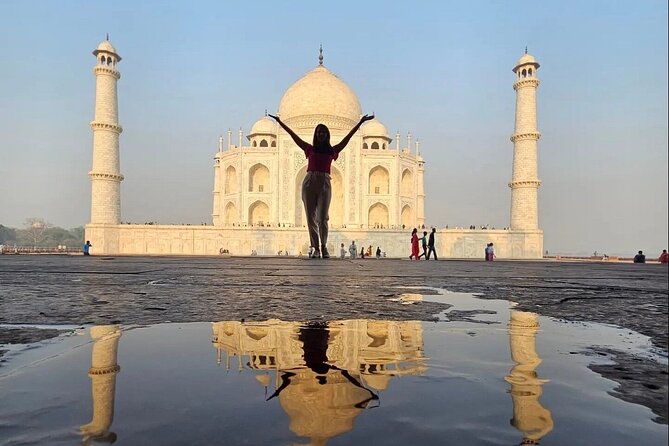
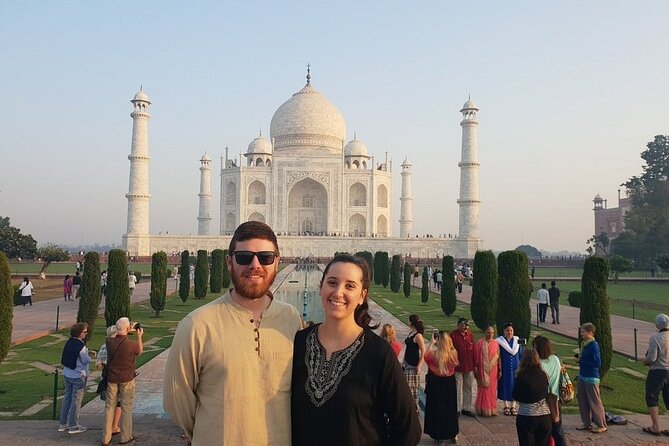
The early start for the Taj Mahal is the right call. Sunrise gives the white marble a changing, gentle light and helps you avoid the harshest part of the day. Plan around three hours at the monument, including the transfer from the parking area by battery bus.
The Taj Mahal was built in the 17th century as a marble mausoleum. Your private guide is intended to help with the entrance process and explain the monument as you move through the grounds. Admission is extra, and the Taj Mahal is closed every Friday, so your starting date matters.
I would not treat the sunrise visit as a quick photo stop. The garden alignment, reflecting pools, main platform, marble screens, and changing view of the dome all reward a slower pace. At the same time, three hours here may feel short if you want extensive photographs or a detailed architectural discussion.
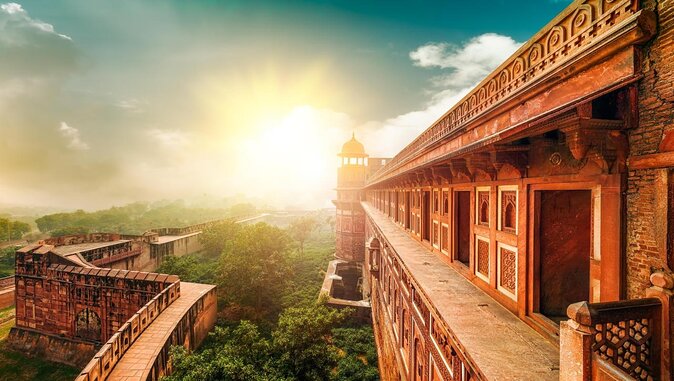
Agra Fort follows, with about one hour planned. Akbar began the red sandstone fort in the 16th century, and Shah Jahan later used parts of it as a palace. Its walls, courtyards, audience halls, and views toward the Taj Mahal show how Mughal power worked in practice. The fort is not simply another palace; it helps explain the political world behind the Taj.
The Tomb of Itimad-ud-Daulah is often called the Baby Taj. Its delicate decoration and Mughal design make it a worthwhile stop after the larger monuments. One hour gives you a calmer visit and a useful comparison with the Taj Mahal, particularly in the use of marble and detailed surface work.
The afternoon drive continues to Fatehpur Sikri. The itinerary highlights Panch Mahal, a five-story palace built under Akbar in the late 16th century. The wider Fatehpur Sikri complex is important, but the planned one-hour stop means you should ask your guide which buildings are included and how much walking is involved.
Fatehpur Sikri adds variety to the day. Instead of seeing only isolated monuments, you get a sense of an imperial city built under Akbar. Afterward, the drive to Jaipur takes about three hours, followed by a hotel drop-off.
This is one of the more demanding days, with an early Taj visit, two Agra monuments, Fatehpur Sikri, and a long transfer. I would keep the evening in Jaipur quiet rather than planning an ambitious night out.
Day three: Jaipur’s palaces, fort, and astronomical instruments
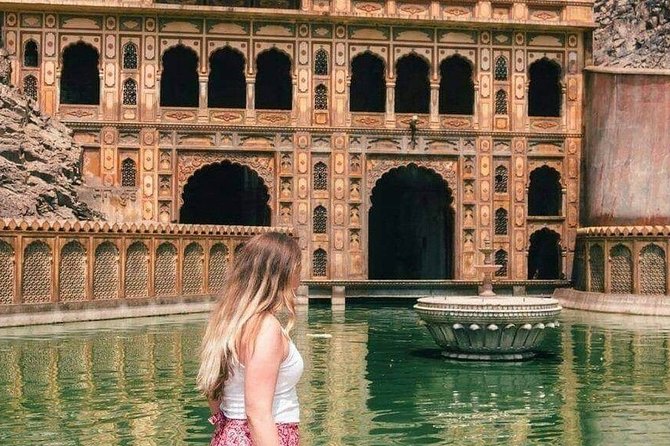
Jaipur sightseeing begins with Hawa Mahal, the Palace of Breeze. Its facade has 953 small windows, designed so royal women could observe street life without being seen. The exterior is especially striking, but the scheduled hour should also give you time to understand how the building worked within the old city.
The City Palace follows with two hours, making it one of the day’s fuller visits. This royal complex combines Rajasthani design with later additions and contains a museum. The longer time is welcome because the complex is more than one photograph: you can move through courtyards, palace rooms, and displays at a more useful pace.
Jal Mahal is a brief 30-minute stop. The Water Palace sits in Man Sagar Lake, and the usual appeal is the view from the shore. The schedule does not promise entry into the palace, so think of this as a scenic pause and photo opportunity rather than a full interior visit.
Amber Fort, also called Amer Fort, is the day’s major historic site. The 16th-century fort shows Rajput architecture through its courtyards, carved details, and defensive setting. One hour is listed, which is enough for a focused route but may feel rushed if you want to explore every section.
The tour specifically says it does not provide elephant activities. That is useful if you want a fort visit without an elephant ride. Your private guide can direct you through the main areas, but ask how the walking route will work, since forts and palace complexes can involve slopes, stairs, and uneven ground.
Jantar Mantar finishes the day. Sawai Jai Singh II built this 18th-century astronomical observatory, which contains large architectural instruments designed to measure time and track celestial movements. Its unusual shapes make more sense with a guide, so this is a stop where explanation adds real value.
Jaipur’s schedule is better balanced than Delhi’s, but it still covers five sites. The advantage of a private vehicle is that you can ask for a little more time at a favorite monument and less time at a stop that does not hold your interest. The practical limit is that the total day still has to fit the listed route.
More Golden Triangle itineraries from New Delhi:
- 3-Days Private Golden Triangle Tour: Delhi, Agra & Jaipur by Car
★ 5.0 · 1,107 reviews - 3-Days Private Golden Triangle Tour: Delhi, Agra & Jaipur by Car
★ 5.0 · 1,098 reviews - 3-Day Delhi, Agra and Jaipur Private Tour – India Golden Triangle
★ 5.0 · 812 reviews - Four-Day Private Luxury Golden Triangle Tour to Agra and Jaipur From New Delhi
★ 5.0 · 807 reviews
Day four: a simple return to Delhi airport
After breakfast, you drive back to Delhi. The tour then drops you at the international airport for your onward flight.
No exact departure time is provided, and the drive duration depends on traffic. I would only use this final transfer when your flight schedule leaves a comfortable buffer. Delhi road conditions can change, and a missed international connection is a high price for squeezing the itinerary too tightly.
Breakfast is included when you choose the hotel-included option, and the details also list four breakfasts. Since the trip covers three nights, confirm the exact meal arrangement at booking, especially if your final breakfast is taken before an early airport departure.
Private cars, hotels, guides, and group size
The vehicle depends on the number of people in your party. Up to two people receive a four-seat sedan, three to four use a six-seat wagon, and groups of five to ten use a ten-seat van. All vehicles are described as private and air-conditioned.
That arrangement is valuable on a road-heavy route. You can keep your own bags with you, stop according to the schedule, and avoid the delays of a large group. It does not remove traffic, heat, or long hours on the road, but it makes those parts easier to manage.
Private local guides are provided for sightseeing, and the guide helps you buy entrance tickets so you do not have to wait in line. The strongest praise connected with this experience centers on the guide’s friendly manner and clear command of the subject. That matters at places such as Jantar Mantar, Fatehpur Sikri, and the Mughal tombs, where a short explanation can turn a collection of buildings into a coherent story.
Hotels are included only when you select the hotel option. Rooms are normally twin-sharing. Three people are assigned a triple-sharing room by default, while two rooms for three people cost extra through the operator. Check this before paying if sleeping arrangements matter to you.
What the extra cost and practical details mean
The tour includes fuel surcharge, hotel taxes, service charges, tolls, parking, bottled mineral water, a soft drink, private transport, guides, and airport or hotel pickup and drop-off. The Taj Mahal battery bus is also covered.
Lunch and gratuities are not included. Monument entry is the main extra expense, estimated at about $55 per person for all the listed sites. Some stops are free, but several of the headline attractions require paid admission, so build this into the real budget.
The tour can be customized, which is helpful if you prefer fewer Delhi stops or more time at the Taj Mahal. Any change should be discussed before the day begins, since the route is already full.
The activity is suitable for most people, and service animals are allowed. It is also described as near public transportation, although the core experience is based on private vehicle transfers. Pickup can be arranged from an airport, railway station, hotel, or other stated location in Delhi and nearby cities. If you request airport pickup, provide your flight details when booking.
Free cancellation is available up to 24 hours before the local start time. Changes or cancellations inside that window are not accepted for a refund.
Who should choose this four-day tour?
I would choose this trip if you have only four days, want the essential monuments, and value a private car over a slower independent route. It suits first-time visitors who want a clear plan and people finishing in Delhi before an international flight.
It also works well for families and small groups because the vehicle size follows the party size, and the route avoids a large coach. The guide support is particularly useful if this is your first visit to India’s major Mughal and Rajput sites.
I would hesitate if you dislike early mornings, long drives, or tightly scheduled sightseeing. You may also prefer a longer itinerary if you want time for local food, shopping, neighborhood walks, or a more relaxed look at Jaipur and Agra.
Should you book it?
Book this Golden Triangle tour if your priority is coverage: Delhi, the Taj Mahal, Agra Fort, Fatehpur Sikri, Jaipur’s palaces, and a Delhi airport finish in four days. The private transport and guide support give the route good practical value, provided you add the roughly $55 monument budget and check the hotel option carefully.
Before booking, confirm your travel dates against the Taj Mahal’s Friday closure and Akshardham’s Monday closure. Choose the earliest Delhi pickup you can manage, verify the exact gurdwara stop, and leave plenty of time for the day-four airport transfer. With those points settled, this is a brisk, well-supported introduction to the Golden Triangle.
FAQ
How long does the Golden Triangle tour last?
The experience lasts approximately four days and includes three nights.
Where can pickup be arranged?
Pickup is offered from hotels, airports, railway stations, or other locations in Delhi, Noida, Gurugram, Ghaziabad, and Faridabad.
Is the tour private?
Yes. Only your group participates, and the tour uses a private air-conditioned vehicle with private local guides.
What vehicle will a small group use?
A group of up to two people uses a four-seat sedan. Three to four people use a six-seat wagon, and groups of five to ten use a ten-seat van.
Are hotel stays included?
Three nights of hotels are included only when you book the option that includes hotels. Rooms are generally twin-sharing, while three people normally share a triple room.
Are monument entrance tickets included?
No. Entry tickets are extra and are estimated at about $55 per person for all monuments.
Is the Taj Mahal open every day?
No. The Taj Mahal is closed every Friday.
What happens on the final day?
After breakfast, you drive from Jaipur to Delhi and are dropped at the international airport for your onward flight.
More 4-Day Experiences in New Delhi
- 4 Days Golden Triangle Tour
★ 5.0 · 499 reviews - Private Luxury Delhi – Agra – Jaipur Golden Triangle Tour – 3 Nights 4 Days
★ 5.0 · 306 reviews - Private 4-Day Golden Triangle Tour with Ranthambore Tiger Safari
★ 5.0 · 248 reviews - From Delhi: Private 4-Day Golden Triangle Luxury Tour
★ 4.8 · 226 reviews
Just added around New Delhi
- Delhi: All-Inclusive Full or Half Day Tour With Hotel Pickup★ 5.0 · 3 reviews
- From Delhi : All Inclusive Taj Mahal Tour by Gatimaan Express★ 5.0 · 3 reviews
- Skip the line: Taj Mahal Agra Private Day Trip From Delhi By Car★ 5.0 · 3 reviews
- New Delhi Night City Tour★ 5.0 · 3 reviews
- Old Delhi Half day private city tour★ 5.0 · 3 reviews
- Delhi: Old and New Delhi One Day Private Guided City Tour★ 5.0 · 3 reviews
- A full-day tour of Old & New Delhi Monument Express Entry★ 5.0 · 3 reviews
- Sultanpur Bird Sanctuary Tour Near Delhi★ 5.0 · 3 reviews
Golden Triangle Tours, compared.
3-Days Private Golden Triangle Tour: Delhi, Agra & Jaipur by Car
Read our review →3-Days Private Golden Triangle Tour: Delhi, Agra & Jaipur by Car
Read our review →
3-Day Delhi, Agra and Jaipur Private Tour – India Golden Triangle
Read our review →
Four-Day Private Luxury Golden Triangle Tour to Agra and Jaipur From New Delhi
Read our review →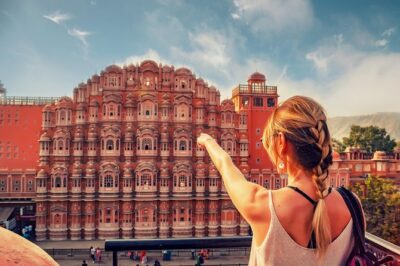
Jaipur Day Trip from Delhi by Car or Train – All Inclusive
Read our review →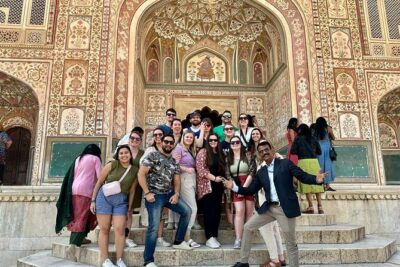
Jaipur City Private Day Tour from Delhi by Car – All Inclusive
Read our review →
5 Nights 6 Days Private Golden Triangle Tour – Delhi Agra Jaipur
Read our review →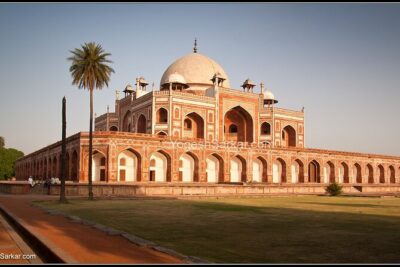
Browse the lists this tour appears in