
Reviewed · GOLDEN TRIANGLE TOURS
Golden Triangle Tour India 4 Days From Delhi
India’s Golden Triangle packs Delhi, Agra, and Jaipur into four busy days, with the Taj Mahal as the emotional high point and Amber Fort, the Red Fort, and Qutub Minar named among the major sights covered by the tour. You travel in a private air-conditioned car rather than joining a large coach group, so the pace can be adjusted to your interests.
I like the combination of three nights in 4-star hotels and most meals, which takes some of the daily planning off your plate. I also like the personal format: your own group travels with a driver and private guide, and a driver named Pankaj has been associated with the tour for his punctual, friendly service. The main drawback is the pace. Six hours of driving on the final day, plus several major monuments in only four days, leaves little room for idle time.
In This Review
- Key points to know before booking
- What this four-day Golden Triangle route really gives you
- Day 1: Old Delhi, the Red Fort, and Jama Masjid
- Day 2: The Taj Mahal, Agra Fort, and Mehtab Bagh
- The marble inlay workshop, a useful extra stop with a sales element
- Day 3: Jaipur’s observatory, palace, and hilltop fort
- Day 4: A six-hour return to Delhi
- Private transport, guides, and the pace of the road
- Hotels, meals, and what the $130 price covers
- Who should book this tour?
- Should you book the Golden Triangle Tour?
- FAQ
- How long does the Golden Triangle tour last?
- Which cities are included?
- Is the tour private?
- What transport is provided?
- Are hotels included?
- Are meals included?
- Can the tour pick me up at the airport?
- What happens on the final day?
Key points to know before booking
- Private car and guide: You travel with your own group in an air-conditioned private car, with personalized attention rather than a fixed large-group schedule.
- Three major cities: The route links Delhi, Agra, and Jaipur, giving you Mughal monuments, Rajput palaces, markets, forts, and modern Indian capital-city sights.
- Three 4-star hotel nights: Hotel accommodation is included for all three nights, along with most meals.
- Flexible sightseeing: The schedule is not described as completely fixed, so you may have some say in how much time you spend at different stops.
- Long road sections: The journey from Jaipur back to Delhi takes about six hours, making the fourth day mainly a transfer day.
- Moderate physical effort: You should be comfortable walking through large forts, palace compounds, markets, and monument grounds.
What this four-day Golden Triangle route really gives you
At $130 per person, this tour is priced as a fast, bundled introduction to North India. The value comes from combining private transport, a guide, three nights in 4-star hotels, most meals, and entrance tickets at the listed sights.
That price does not cover personal expenses, so budget separately for shopping, optional purchases, snacks outside the included meals, and anything not specifically listed. The arrangement suits you best if you want to see a lot without arranging every hotel, transfer, guide, and monument visit yourself.
The route also has a useful mix. Delhi gives you imperial and Mughal landmarks, Agra provides the Taj Mahal and Agra Fort, and Jaipur shifts the mood toward Rajput forts, royal residences, and planned-city architecture. You will not experience each city at a relaxed pace, but you will get a clear first look at three of northern India’s best-known cultural centers.
Because this is a private tour, your group is the only group participating. That matters in India, where traffic, heat, queues, and crowded market streets can make a rigid schedule tiring. The tour has room for some adjustment, although the long distances still set the basic rhythm.
More Golden Triangle itineraries from New Delhi:
- 3-Days Private Golden Triangle Tour: Delhi, Agra & Jaipur by Car
★ 5.0 · 1,107 reviews - 3-Days Private Golden Triangle Tour: Delhi, Agra & Jaipur by Car
★ 5.0 · 1,098 reviews - 3-Day Delhi, Agra and Jaipur Private Tour – India Golden Triangle
★ 5.0 · 812 reviews
Day 1: Old Delhi, the Red Fort, and Jama Masjid
The tour begins with pickup at Indira Gandhi International Airport, Terminal 3, followed by a transfer to your hotel. A traditional welcome is included, and the airport reception takes about 30 minutes. If you have just arrived on an international flight, this first transfer and hotel check-in provide a useful buffer before sightseeing begins.
The first major visit is the Red Fort, the Mughal-era citadel that gives Old Delhi its grandest historic setting. Allow about an hour here. The fort is not simply a single building to photograph. It is a large complex of walls, gateways, courtyards, and former royal spaces, so comfortable shoes and water will help.
Next comes Jama Masjid, one of Old Delhi’s major mosques. The planned visit lasts about an hour. Since the tour specifies a formal dress code, dress conservatively for religious and historic sites. This is especially important at Jama Masjid, where respectful clothing is part of making the visit go smoothly.
The day ends around Chandni Chowk, Old Delhi’s traditional market district. The scheduled stop is 30 minutes, with time in the evening for shopping and dinner at a traditional restaurant. I would treat this as an introduction rather than a full market exploration. Chandni Chowk can be intense, and half an hour gives you a quick taste of its lanes, shops, and street activity without taking too much time from the rest of the route.
One practical point: the supplied itinerary names Qutub Minar as one of the tour highlights, but the day-by-day schedule shown here does not assign it a separate stop. If Qutub Minar is important to you, ask the operator before departure how it fits into your particular schedule. With only four days, adding another major monument may require shortening another visit.
Day 2: The Taj Mahal, Agra Fort, and Mehtab Bagh
The second day is the emotional center of the trip. The Taj Mahal receives about two hours, enough to see the monument, move through the surrounding complex, and spend time looking at the marble details rather than simply taking a quick picture.
The Taj Mahal was built in Agra between 1631 and 1648 by Mughal emperor Shah Jahan as a mausoleum for his favorite wife. Its white marble, balanced design, and changing appearance in different light explain why it remains the country’s best-known monument. Your guide can provide the historical frame, but you should also protect a little quiet time to take in the building itself.
Two hours sounds generous on paper, but the Taj Mahal is the kind of place where the clock moves quickly. The complex includes more than the central mausoleum, and you may want time for views from different angles. Since the tour is private, it is worth telling your guide if you prefer a slower visit here and a shorter stop elsewhere.
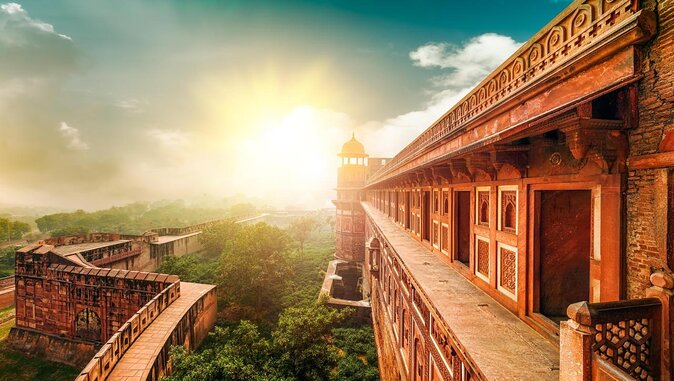
Agra Fort follows, with about an hour scheduled. This is an important counterpoint to the Taj Mahal. The Taj is a mausoleum built around memory and symmetry, while Agra Fort shows the working and defensive side of Mughal power. It was the main residence of Mughal emperors until the capital moved from Agra to Delhi in 1638.
The fort is extensive, so one hour will give you a focused visit rather than a complete examination of every section. You will see imposing walls and royal spaces, and the site helps explain how the Mughal court functioned. If the Taj Mahal is your main reason for booking, Agra Fort makes the day more than a single-monument photo stop.
The final Agra visit is Mehtab Bagh, a garden on the Yamuna River opposite the Taj Mahal. The planned stop lasts about an hour. Its position gives you a different way to look at the monument, away from the main entrance and from across the river.
The itinerary describes Mehtab Bagh as a garden originally built by Emperor Babur as the last in a series of 11 gardens on the Yamuna’s eastern bank. The visit is valuable because it changes your view of the Taj. Instead of standing directly before the marble facade, you see how the building relates to the river and its wider setting.
The marble inlay workshop, a useful extra stop with a sales element
Before continuing to Jaipur on Day 3, the tour includes a visit to a marble inlay workshop. The purpose is to show you the craft connected with the Taj Mahal, including the history and techniques of white-marble inlay work.
This can be a worthwhile stop if you want to understand the small-scale craftsmanship behind the monument’s decorative surfaces. It also has a practical side: workshop visits often include a chance to buy products. The tour description does not list purchases as included, so treat shopping as optional and keep personal spending in mind.
You should also note that the timing is tight. The route moves from Agra to Jaipur, and the day includes several Jaipur sights after arrival. If you prefer architecture and history to shopping, tell the guide how you want the available time divided.
A few more New Delhi departures worth comparing
- 4 Days Golden Triangle Tour
★ 5.0 · 499 reviews - Private Luxury Delhi – Agra – Jaipur Golden Triangle Tour – 3 Nights 4 Days
★ 5.0 · 306 reviews - Private 4-Day Golden Triangle Tour with Ranthambore Tiger Safari
★ 5.0 · 248 reviews - From Delhi: Private 4-Day Golden Triangle Luxury Tour
★ 4.8 · 226 reviews
Day 3: Jaipur’s observatory, palace, and hilltop fort
Jaipur brings a different visual style to the trip. The city’s major buildings reflect Rajput traditions alongside Mughal influence, and the scheduled stops show three sides of Jaipur: science and timekeeping, royal life, and military architecture.
Jantar Mantar is the first listed Jaipur sight, with about an hour planned. This historic astronomical site is made up of large instruments designed to measure time and track celestial positions. Its scale can surprise you. It is less about ornate decoration and more about how mathematics was made visible in stone.
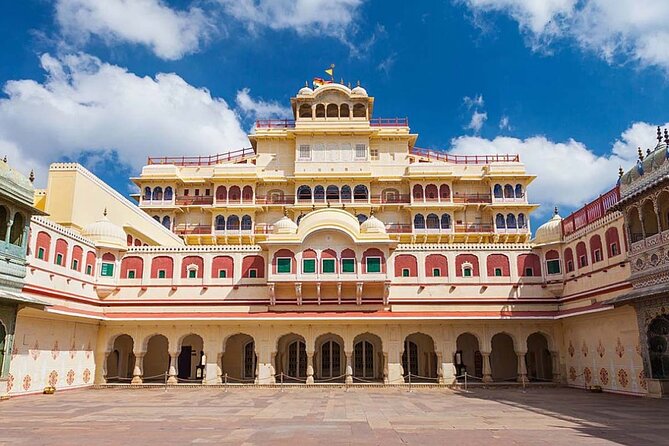
The City Palace comes next. Located in the heart of Jaipur’s old city, the palace complex occupies about one-seventh of the old city area. It combines Rajput and Mughal architectural elements and includes the seven-storey Chandra Mahal at its center.
One hour gives you a useful overview, but not a leisurely examination of every room and courtyard. The City Palace is a good place to focus on the contrast between ceremonial spaces, defensive planning, and royal design. Ask your guide to point out the details that show the two architectural traditions working together.
Amber Fort is the longest Jaipur stop, at about two hours. The old capital of the Kachhwaha rulers sits on a range of rugged hills, giving the fort its dramatic setting. The tour description includes a Jeep ride to reach the uphill fort, which helps reduce the effort of climbing the approach.
Even with the Jeep ride, expect walking across uneven surfaces and through a large complex. Two hours is a sensible minimum for seeing the main courtyards and palace areas, but the site can easily absorb more time. This is one of the stops where the private format helps. If Amber Fort is your priority, you can ask for a stronger focus here rather than rushing through every palace room.
The day ends with Jal Mahal, the small palace set in the middle of Man Sagar Lake. The driver stops for about 10 to 15 minutes for photography, although the itinerary assigns one hour to the stop. Renovation work around the lake is noted, so the appearance of the surrounding area may change.
Jal Mahal is best treated as a short roadside photo stop, not a full palace visit. Its position in the water makes it visually different from the other Jaipur sights, but the schedule does not describe an interior visit.
Day 4: A six-hour return to Delhi
The final day is mostly transportation. After leaving Jaipur, you return to Delhi in a drive of about six hours, with drop-off at your own booked hotel or at Delhi International Airport.
This arrangement is useful if you are flying onward or already have a Delhi hotel booked. It is less useful if you expect a final day of sightseeing. Plan your departure carefully, since traffic and road conditions can affect the exact arrival time, and the tour data does not promise a sightseeing stop on the return journey.
The ability to finish at either a hotel or the airport adds practical value. You do not need to arrange a separate intercity transfer, but you do need to provide your own onward accommodation if you are staying in Delhi.
Private transport, guides, and the pace of the road
The private air-conditioned car is one of the strongest features of this experience. Delhi, Agra, and Jaipur are connected by long road sections, and a private vehicle gives you more control than a large shared bus. You can speak directly with the driver, ask for comfort breaks, and discuss the order or length of sightseeing stops.
The package includes a driver, a private tour guide, and a private air-conditioned car. The guide may be multilingual. The experience has also featured a driver named Pankaj, described in connection with punctual and friendly service. If a particular driver matters to you, confirm availability before booking rather than assuming a named person will be assigned.
The private setup does not erase the distance between the cities. This is still a packed four-day circuit. You will spend meaningful time inside forts, mosques, palaces, gardens, and monument grounds, but you will also spend several hours on the road. I would choose this tour for coverage and convenience, not for a slow, restful holiday.
Hotels, meals, and what the $130 price covers

Three nights in 4-star hotels and most meals are included. For a first visit, this simplifies the trip considerably. You can concentrate on the sights instead of arranging a new hotel and restaurant plan in each city.
The value depends on how much you would otherwise spend on private transportation, guides, monument tickets, and accommodation. At $130 per person, the package is attractive for someone who wants these main costs combined in one booking. The price is less complete than it may first appear because personal expenses are excluded.
Keep money available for shopping in Chandni Chowk, the marble workshop, and any other purchases. The tour includes most meals, not every meal, so you should also expect some food costs outside the included plan.
Who should book this tour?
I would recommend it to a first-time visitor who has only four days and wants the main Golden Triangle landmarks handled in one private arrangement. It is also a good fit for couples, families, or small groups who value a private car and the ability to discuss the day with their guide.
You should be comfortable with a moderate level of physical activity. The forts and palace complexes involve walking, and the schedule moves quickly from one major site to the next. Conservative, formal clothing is required, so pack outfits suitable for religious and historic places.
This is not the best choice if you want long mornings at one monument, relaxed meals, or several unplanned hours in each city. The route is efficient because it is busy. That tradeoff is the whole point.
Free cancellation is available if you cancel at least 24 hours before the experience start time. Changes made within 24 hours are not accepted, and cancellations inside that period are not refunded.
Should you book the Golden Triangle Tour?
Book it if you want a high-coverage, private introduction to Delhi, Agra, and Jaipur at a modest bundled price. The Taj Mahal, Agra Fort, Amber Fort, Red Fort, Jama Masjid, City Palace, Jantar Mantar, and Jal Mahal give you a strong first look at North India’s architecture and history.
Think twice if your schedule cannot handle long drives or if you want every important sight, including Qutub Minar, confirmed in detail. Before paying, ask how the actual hotel names, meal plan, Qutub Minar visit, and daily departure times will be arranged. With those points clear, this is a practical way to see the Golden Triangle when time is short.
FAQ
How long does the Golden Triangle tour last?
The tour lasts approximately four days and includes three nights of accommodation.
Which cities are included?
The route covers New Delhi, Agra, and Jaipur.
Is the tour private?
Yes. Only your group participates in the private tour or activity.
What transport is provided?
The package includes a private air-conditioned car, a driver, and a private tour guide.
Are hotels included?
Yes. Three nights in 4-star hotels are included.
Are meals included?
Most meals are included, but personal expenses and other items not covered by the package are excluded.
Can the tour pick me up at the airport?
Yes. Pickup is offered, and the first scheduled stop is at Indira Gandhi International Airport Terminal 3 in Delhi.
What happens on the final day?
You return to Delhi after a drive of about six hours and are dropped at your own booked hotel or at Delhi International Airport.
Just added around New Delhi
- Delhi: All-Inclusive Full or Half Day Tour With Hotel Pickup★ 5.0 · 3 reviews
- From Delhi : All Inclusive Taj Mahal Tour by Gatimaan Express★ 5.0 · 3 reviews
- Skip the line: Taj Mahal Agra Private Day Trip From Delhi By Car★ 5.0 · 3 reviews
- New Delhi Night City Tour★ 5.0 · 3 reviews
- Old Delhi Half day private city tour★ 5.0 · 3 reviews
- Delhi: Old and New Delhi One Day Private Guided City Tour★ 5.0 · 3 reviews
- A full-day tour of Old & New Delhi Monument Express Entry★ 5.0 · 3 reviews
- Sultanpur Bird Sanctuary Tour Near Delhi★ 5.0 · 3 reviews
Golden Triangle Tours, compared.
3-Days Private Golden Triangle Tour: Delhi, Agra & Jaipur by Car
Read our review →3-Days Private Golden Triangle Tour: Delhi, Agra & Jaipur by Car
Read our review →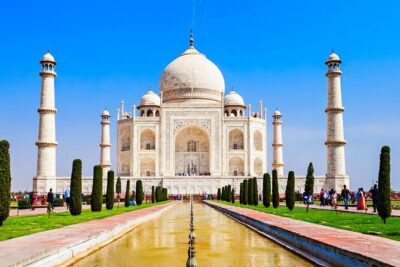
3-Day Delhi, Agra and Jaipur Private Tour – India Golden Triangle
Read our review →
Four-Day Private Luxury Golden Triangle Tour to Agra and Jaipur From New Delhi
Read our review →
Jaipur Day Trip from Delhi by Car or Train – All Inclusive
Read our review →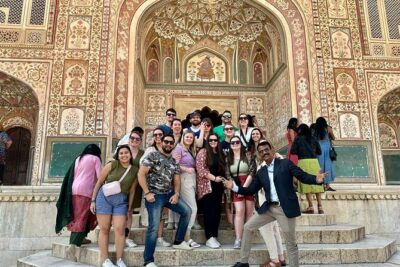
Jaipur City Private Day Tour from Delhi by Car – All Inclusive
Read our review →
5 Nights 6 Days Private Golden Triangle Tour – Delhi Agra Jaipur
Read our review →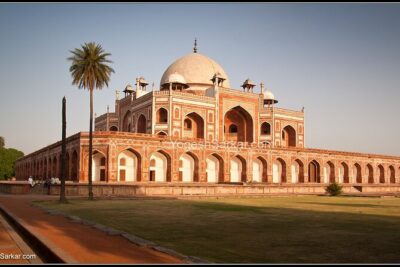
Browse the lists this tour appears in